Reduced Order Modeling for Incompressible Flows
Overview
This project investigates projection-based reduced-order models (ROMs) for incompressible Navier-Stokes equations. By extracting dominant spatial modes using Proper Orthogonal Decomposition (POD) from high-fidelity finite element (FEM) snapshots, the study constructs a low-dimensional Galerkin projection. The framework is evaluated on a 2D lid-driven cavity flow at (Re = 400) and (1000), and a 2D circular cylinder experiencing periodic vortex shedding at (Re = 100) and (1000).
Results
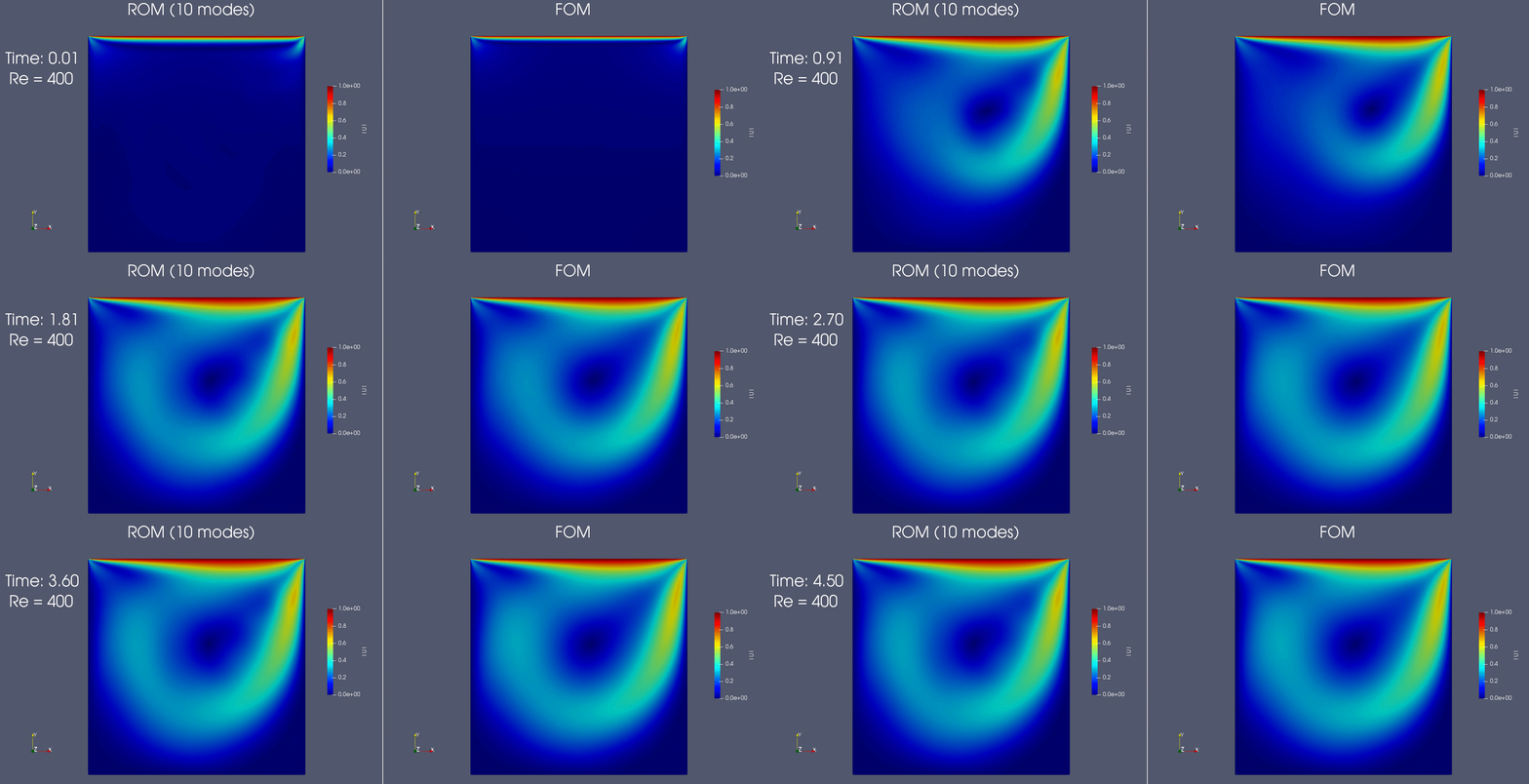
For the lid-driven cavity, a 10-mode ROM successfully captures approximately 99% of the system’s energy, reproducing the full-order model (FOM) velocity and pressure fields with excellent stability and no need for supremizer enrichment.
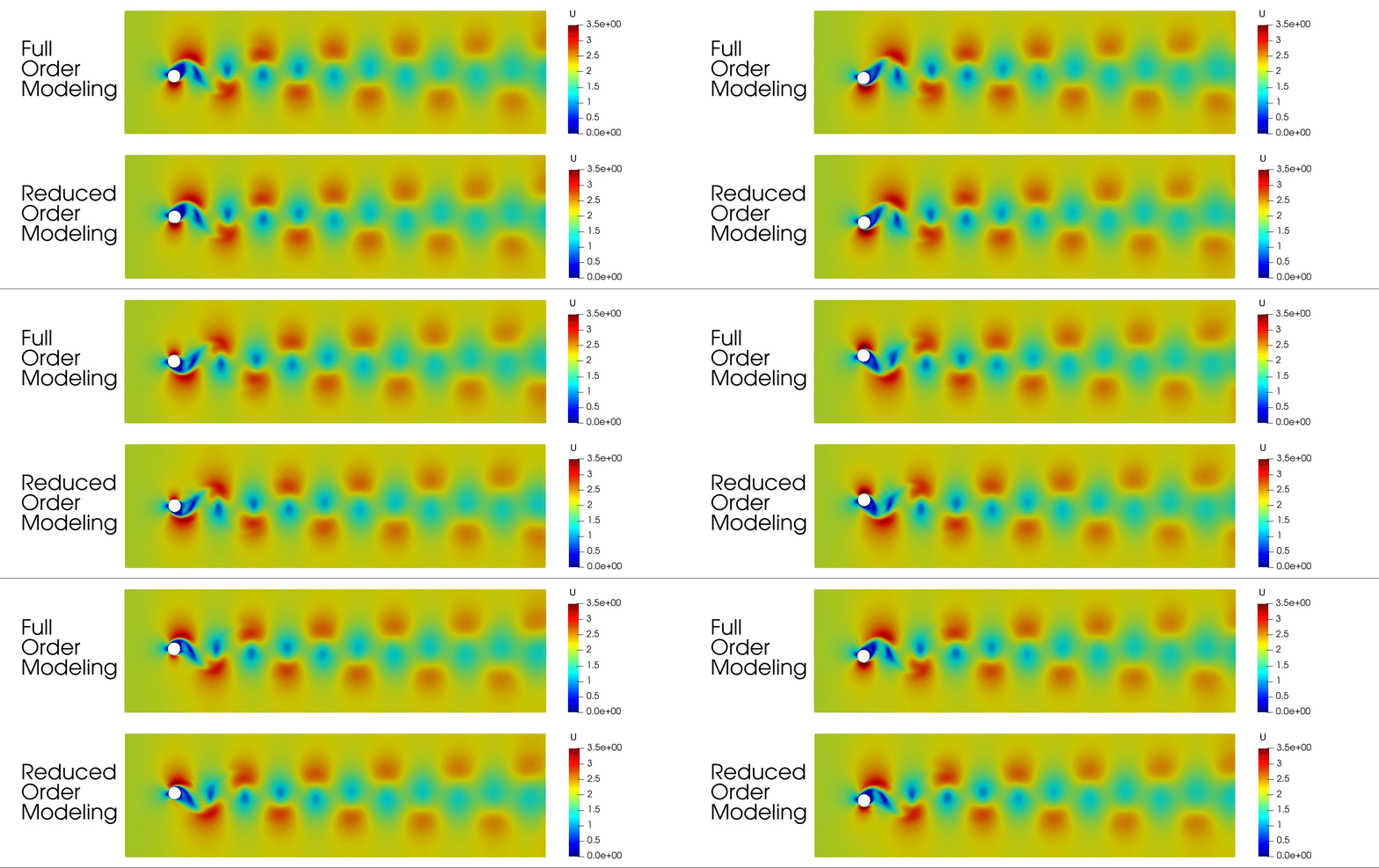
In the cylinder flow, the 15-mode ROM accurately reconstructs and predicts the transient vortex shedding, matching the lift and drag forces of the FOM.
Limitations & Future Work: The standard POD-Galerkin ROM lacks parametric generalizability and can face stability challenges under highly transient, 3D turbulent flows with dynamically changing boundary conditions. Future work aims to integrate nonlinear manifold learning techniques, such as autoencoders and neural network-based closure modeling, to enhance performance in highly non-linear regimes.
Visualizations